
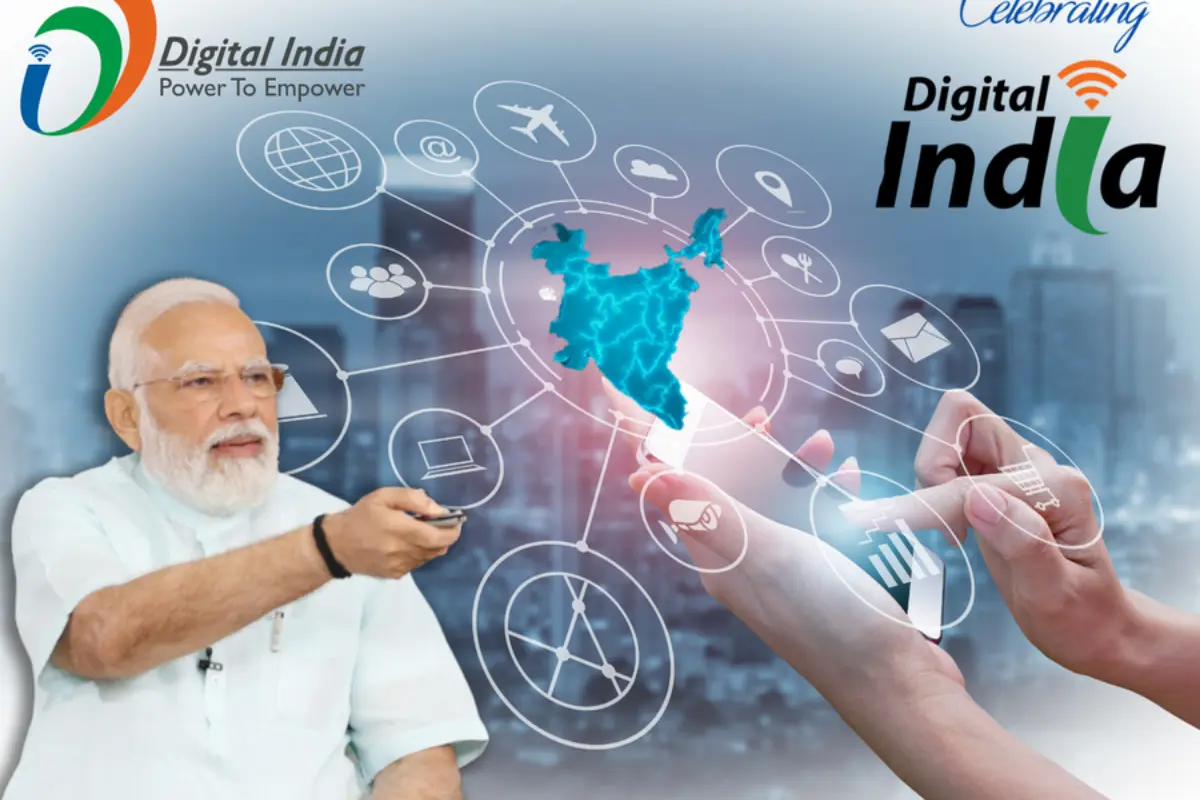
As Digital India completes 10 years, Prime Minister Narendra Modi marked the occasion by declaring the flagship programme not just a government initiative but a “people’s movement” that has empowered every corner of the country.
In a reflective and visionary blog post on LinkedIn, PM Modi revisited the roots of Digital India, recalling the skepticism that shrouded its launch in 2015. “While decades were spent doubting the ability of Indians to use technology, we changed this approach and trusted the ability of Indians to use technology,” he wrote, emphasizing the nation’s shift from hesitation to innovation.
Back in 2014, India stood at the edge of a digital divide. Internet penetration was minimal, digital literacy was confined to urban clusters, and accessing government services online was a distant dream. Fast-forward to today, and those doubts have been shattered by the sheer scale of transformation experienced by 140 crore Indians.
“From how we govern to how we learn, transact, and build, Digital India is everywhere,” said Modi, celebrating the grassroots adoption of technology across India’s vast and diverse geography.
Digital India: A Decade of Unprecedented Digital Growth
Since its inception, Digital India has catalysed the country’s digital economy and empowered millions. From only 25 crore internet connections in 2014, India now boasts 97 crore connections. What once seemed unimaginable—connecting the remotest of villages—is today a reality, with over 42 lakh kilometres of Optical Fibre Cable laid, spanning a distance 11 times that between Earth and the Moon.
India’s digital infrastructure has evolved at a staggering pace. Its 5G rollout, completed in just two years with 4.81 lakh base stations, ranks among the fastest in the world. The network now reaches not just urban hubs but remote defence outposts like Galwan, Siachen, and Ladakh, proving that digital strength is now synonymous with national strength.
Digital Tools, Real Impact
The Prime Minister lauded India Stack, the nation’s digital framework, for making platforms like UPI (Unified Payments Interface) an everyday part of Indian life. Handling over 100 billion transactions a year, UPI has become a global benchmark in real-time digital payments. Today, half of all real-time digital transactions in the world happen in India.
Similarly, Direct Benefit Transfer (DBT) has redefined public service delivery. With Rs 44 lakh crore directly credited to citizens, it has eliminated middlemen and saved Rs 3.48 lakh crore in leakages, transforming subsidy and welfare disbursements.
Another cornerstone of the decade-long journey is the Open Network for Digital Commerce (ONDC), which has just surpassed 200 million transactions, with the last 100 million completed in under six months. PM Modi highlighted how ONDC is bridging digital commerce gaps by empowering small businesses and artisans. “From Banarasi weavers to bamboo artisans in Nagaland, sellers are now reaching customers nationwide, without middlemen or digital monopolies,” he said.
Digital India: Empowering Enterprises and Innovators
The government’s GeM (Government e-Marketplace) platform has also seen exponential growth, crossing Rs 1 lakh crore GMV in just 50 days. It now hosts over 22 lakh sellers, including 1.8 lakh women-led MSMEs, who have fulfilled orders worth Rs 46,000 crore. This democratisation of public procurement is creating new pathways for micro and small enterprises to thrive.
In a bold push towards AI supremacy, the government has launched the $1.2 billion India AI Mission, offering access to 34,000 GPUs at a globally unmatched cost, less than $1 per GPU hour. PM Modi described this initiative as a leap toward making India the most affordable computing destination in the world.
Also Read : India: Economic Growth Stumbles in May 2025