
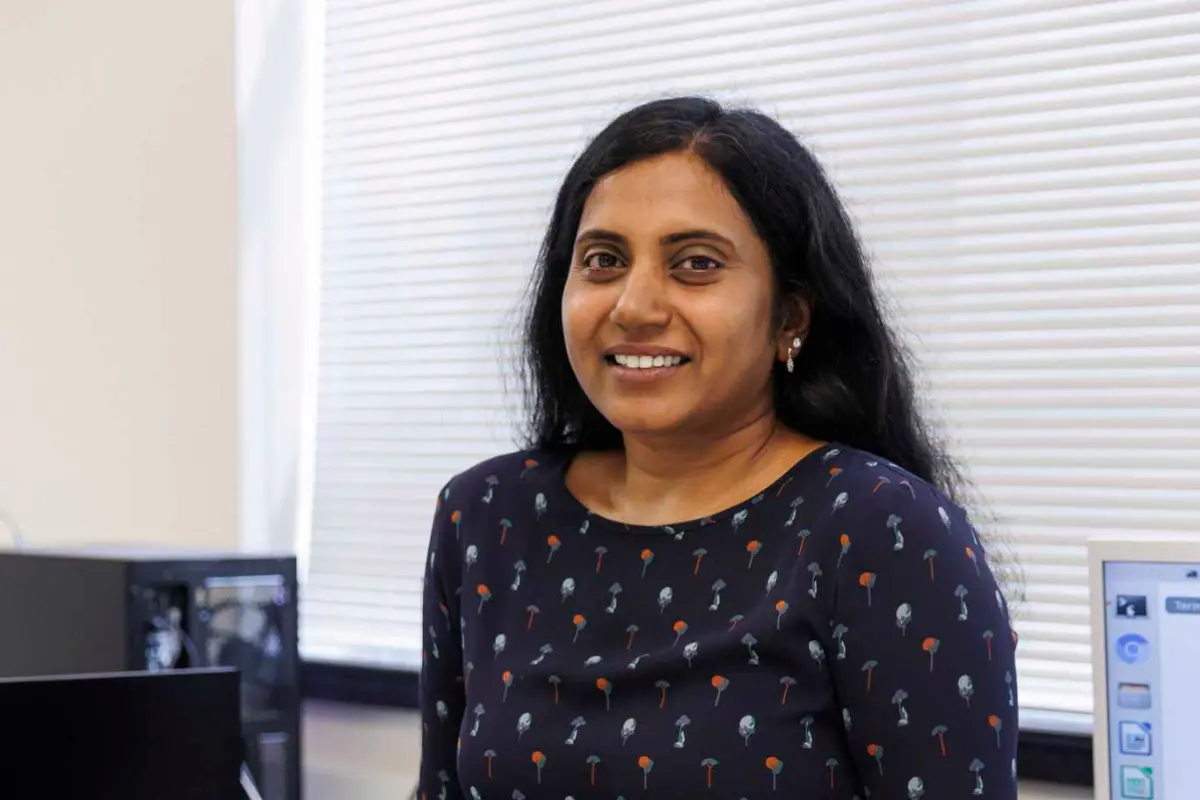
The story of Dhireesha Kudithipudi is one of courage, curiosity, and conviction. A first-generation and first PhD graduate from the Electrical Engineering program at the University of Texas at San Antonio, she broke new ground long before neuromorphic computing became a strategic national priority.
Her doctoral research in 2006 focused on static power optimization mechanisms—an early indication of her lifelong commitment to energy-efficient computing. Her groundbreaking work earned her the Outstanding PhD Research Award and marked the beginning of a career devoted to solving one of AI’s most pressing challenges: how to make intelligent systems powerful yet sustainable.
Before academia, she briefly explored the software industry as a programmer and systems analyst. But it was during her master’s studies at Wright State University that she first encountered neural networks. That exposure sparked a fascination with systems that learn like humans—a fascination that would shape the trajectory of her life’s work.
She began her academic journey with a BTech in Electrical and Electronics Engineering from Nagarjuna University, building a strong foundation that bridged hardware, software, and intelligence.
Dhireesha Kudithipudi: Building Institutions, Not Just Ideas
In Fall 2019, Dhireesha Kudithipudi returned to UTSA as the Robert F. McDermott Endowed Chair in Engineering and Professor with a joint appointment in Electrical and Computer Engineering and Computer Science. Her return was not symbolic—it was catalytic.
At UTSA, she founded and directs the Neuromorphic AI (NuAI) Lab, where her team designs next-generation AI accelerators, explores memristor-based architectures, and pioneers lifelong learning systems. The lab’s mission is ambitious yet clear: to create brain-inspired AI systems that can adapt, reason, and evolve without exhausting planetary resources.
Her influence extends beyond the laboratory. As Founding Director of the MATRIX AI Consortium for Human Well-Being, Dhireesha Kudithipudi has united researchers across disciplines—from engineering and medicine to neuroscience and public policy. MATRIX connects UTSA, UT Health San Antonio, Southwest Research Institute, and Texas Biomedical Research Institute in a shared mission: to develop AI systems that enhance human life.
Through MATRIX, she has fostered collaborations with organizations such as MISI Dreamport and BigBear.ai, convening symposia on AI and quantum computing that examine how emerging technologies will redefine humanity’s relationship with data.
THOR: The Neuromorphic Commons
The launch of THOR represents a defining chapter in Dhireesha Kudithipudi’s career. Backed by the National Science Foundation, THOR is designed as an open-access national resource—a collaborative ecosystem where researchers, startups, and students can experiment with neuromorphic hardware and software platforms.
Neuromorphic computing, inspired by the architecture of the human brain, holds the key to solving AI’s energy crisis. Traditional machine learning models demand enormous computational resources and power. In contrast, neuromorphic systems operate through spiking neural networks and event-driven architectures, dramatically reducing energy consumption.
Under her leadership, THOR aims to democratize access to these transformative technologies. It is not just about advancing research; it is about building infrastructure that ensures the United States remains competitive in sustainable AI innovation.
Dhireesha Kudithipudi: Research That Thinks Like the Brain
Dhireesha Kudithipudi’s research focuses on three core pillars:
1. Neuromorphic Computing
Designing hardware and software systems that emulate the brain’s structure and function, enabling real-time, low-power intelligence.
2. Lifelong Learning Systems
Developing AI models capable of continuous adaptation without catastrophic forgetting—mirroring how humans accumulate knowledge over time.
3. Novel Computing Substrates
Exploring emerging technologies such as memristors and 3D integrated circuits (3D-ICs) to build AI-on-chip platforms that integrate memory and computation seamlessly.
Her team has published over 100 peer-reviewed articles in neuromorphic AI, with research featured in leading outlets including IEEE Signal Processing Magazine and Nature Outlook. Their work has earned multiple best paper awards at CVPR-W, NICE, and AI Summit conferences.
She has also served as a panelist at Department of Defense and Air Force Office of Scientific Research roundtables, contributing strategic insight into the national future of neuromorphic R&D.
A Voice in National Policy and Industry
Beyond academia, Dhireesha Kudithipudi has actively shaped conversations around AI policy and workforce development. She has worked with New York state policymakers on AI investment strategies and participated in bipartisan Capitol Hill roundtables addressing the societal impact of artificial intelligence.
Her expertise has been sought by federal agencies and research institutions including AFOSR, DOE, NSF/NIST, ARL, Seagate, and national laboratories. She also consults for AI startups, helping bridge the gap between research breakthroughs and real-world deployment.
Her approach is grounded in a simple yet powerful belief: AI must serve humanity, not overwhelm it.
Championing Diversity in AI
Equally central to Dhireesha Kudithipudi’s mission is diversifying the AI pipeline. She understands that innovation thrives when voices from all backgrounds are represented.
She has led the Google CS4HS workshop for three consecutive years—recognized by Google’s education outreach as an exemplary site—bringing computer science training to teachers and students from underrepresented communities.
Today, she leads Project Lovelace, supported by the Xilinx Foundation, to advance career pathways for women in AI. Through mentorship, outreach, and structured research opportunities, she is ensuring that the next generation of AI leaders reflects the diversity of the society it serves.
Recognition and Honors
The excellence of Dhireesha Kudithipudi’s work has been widely recognized:
-
ELATE Fellow (Executive Leadership in Academic Technology and Engineering) at Drexel University (2022)
-
San Antonio Lights Award (2022)
-
Rochester’s Technology Woman of the Year (2018)
-
Clare Boothe Luce Scholarship in STEM (2018)
-
U.S. Air Force Research Lab Summer Faculty Fellowship (2014)