
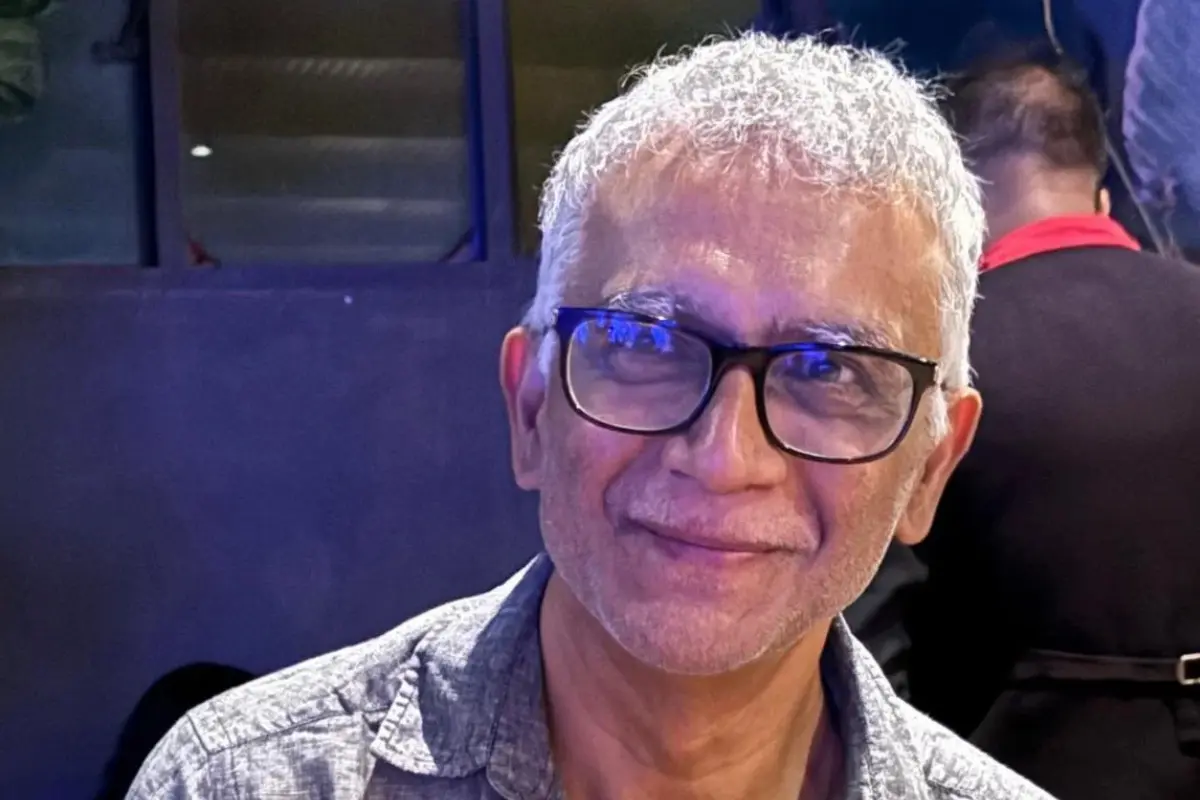
Born in India and educated at one of the country’s most prestigious institutions, Anil Ananthaswamy graduated in 1985 with a Bachelor of Technology in Electronics and Electrical Engineering from the Indian Institute of Technology, Madras (IIT-M). The discipline of engineering instilled in him a deep respect for logic, systems, and precision—skills that would later underpin his science writing.
He went on to earn a master’s degree from the University of Washington, Seattle, before entering the heart of Silicon Valley during the 1990s. There, Ananthaswamy worked as a distributed systems software engineer and architect, contributing to the rapidly evolving world of computing.
Yet, despite professional success, something was missing.
Anil Ananthaswamy: A Courageous Pivot: From Code to the Written Word
For many, leaving a stable and respected engineering career would seem unthinkable. For Anil Ananthaswamy, it was necessary. Devoid of a deeper sense of fulfillment, he returned to a passion that had quietly accompanied him all along—writing.
Before ever becoming a science journalist, Ananthaswamy was already a published author. In 1995, he wrote a textbook on object-oriented programming and data structures, demonstrating an early ability to explain complex ideas with clarity. Still, he sought a more expansive creative and intellectual canvas.
This realization led him to the University of California, Santa Cruz, where he enrolled in the graduate program in science communication. In 2000, following his studies, he secured a six-month internship at New Scientist magazine in London—a pivotal moment that would redefine his life.
New Scientist and the Rise of a Global Science Voice
Anil Ananthaswamy’s talent quickly became unmistakable. He joined New Scientist as a staff writer and eventually rose to become deputy news editor. His reporting combined technical mastery with narrative depth, tackling subjects ranging from cosmology and quantum mechanics to neuroscience and computation.
His work soon appeared in some of the world’s most respected publications, including Quanta, Scientific American, Nature, PNAS Front Matter, Nautilus, Matter, Discover, The Wall Street Journal, and the UK’s Literary Review. Across platforms, Ananthaswamy became known for asking not just how science works, but why it matters.
Anil Ananthaswamy: Books That Changed the Conversation
The Edge of Physics (2010)
Ananthaswamy’s debut popular science book explored the frontiers where known physics begins to unravel. The same year, he received the Institute of Physics’ inaugural Physics Journalism Prize for his landmark feature “Hip Hip Array,” detailing the visionary Square Kilometre Array telescope.
The Man Who Wasn’t There (2015)
This deeply human exploration of neuroscience and identity examined disorders that challenge conventional ideas of the self. The book was long-listed for the 2016 PEN/E. O. Wilson Literary Science Writing Award, cementing Ananthaswamy’s reputation for blending empathy with scientific rigor.
Through Two Doors at Once (2018)
A masterful journey into quantum mechanics and the enduring mystery of the double-slit experiment, this book was named one of Smithsonian’s Favorite Books of the Year and featured on Forbes’ Best Books on Astronomy, Physics, and Mathematics list.
Why Machines Learn (2024)
His most recent work explores the mathematical elegance behind modern artificial intelligence. Widely acclaimed upon release, the book was described as a “masterpiece” by Nobel laureate and AI pioneer Geoffrey Hinton, marking a defining moment in contemporary science writing.
Investigative Depth and Ethical Storytelling
In 2013, Anil Ananthaswamy received an award for best investigative journalism for his long-form feature in MATTER magazine on Body Integrity Identity Disorder—a rare neurological condition that challenges deeply held assumptions about body, mind, and autonomy. The piece exemplified his ability to handle sensitive topics with compassion, intellectual honesty, and narrative restraint.
Educator, Mentor, and Builder of Future Voices
Beyond writing, Anil Ananthaswamy has dedicated himself to nurturing the next generation of science communicators. Since 2011, he has organized and taught an intensive annual two-week science journalism workshop at the National Centre for Biological Sciences in Bengaluru, mentoring small cohorts of writers from across India.
In 2019, he was selected as a Knight Science Journalism Fellow at the Massachusetts Institute of Technology, where he deepened his engagement with machine learning and neural networks. His learning continued through advanced training via eCornell and immersive exposure to cutting-edge research.
Until April 2025, Ananthaswamy served as journalist-in-residence at the Simons Institute for the Theory of Computing, University of California, Berkeley, further strengthening ties between theoretical science and public understanding.